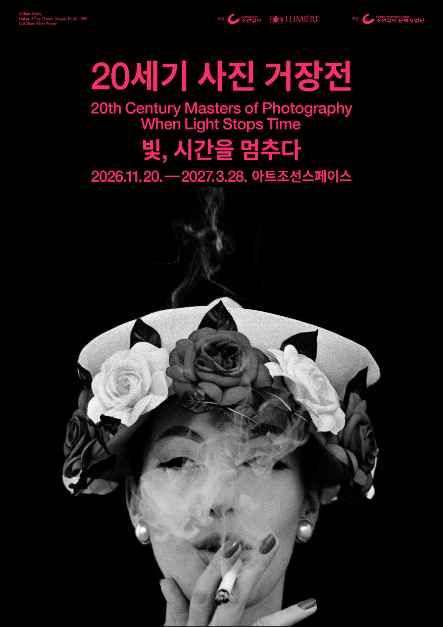
20th-Century Masters of Photography Exhibition — Light, Stopping Time
In an age when hundreds of millions of images are easily born on liquid-crystal screens every day and casually vanish with a single swipe of a finger, the proliferation of digital technology and artificial intelligence has enabled anyone to capture and reproduce moments with ease. Amid a maze of weightless pixels, the profound resonance and afterimage conveyed by analog photography are gradually fading. As effortless production and consumption repeat, we are losing the “authenticity of looking”—the act of observing a subject deeply and for a long time. From the moment of its birth, photography was both a physical exploration mediated by light and an art of time that captures and preserves a cross-section of time in motion. The masterpieces created by the hands of 20th-century masters were not mere reproductions of phenomena through cold machines. They embodied each artist’s distinctive philosophy of confronting and interpreting the world. As a concept contrasted with digital images, photographic works developed and printed using analog methods are called “physical prints.” These photographs were completed as particles of silver salts—photosensitive compounds combining silver and halogen elements—and the texture of platinum permeated the photographic paper beneath the red light of the darkroom. In these crystallizations of “silver alchemy,” one can fully sense even the air, temperature, and trembling wind of the moments when the masters held their breath and pressed the shutter. This is the weighty texture of analog printing that can never be captured on a digital screen. It is both the “weight of physical time” endured on site and a sublime trace left by aesthetic labor. The special exhibition, “20th-Century Masters of Photography Exhibition — Light, Stopping Time,” was organized through a careful selection from the unrivaled collection of Gallery Lumiere. It brings together in one place around 80 masterpieces by 17 internationally renowned masters who established and brought modern photography to fruition, including Henri Cartier-Bresson (1908-2004), Tina Modotti (1896-1942), and William Klein (1926-2022). Rather than merely looking back on masterpieces from a past century, the exhibition offers a contemplative journey following the gazes of masters who loved and observed the world more passionately than anyone else. From pioneers of modern photography who elevated the medium to the ranks of fine art, through masters who emphasized pure humanism, to documentary masters who testified to the dynamism of cities and the profound inner lives of human beings, it examines from multiple angles the trajectory of an era inscribed in light. Although people today are surrounded by rapidly consumed digital media, they paradoxically yearn for the warmth of analog. This exhibition seeks to offer a place to pause within serene shades of black and white, away from the lightness of fleeting digital frames. Visitors are encouraged to stop for a long while before each photograph and, as though reading a thoughtfully handwritten letter, listen for the masters’ breathing flowing between the fine black-and-white grains, where they may feel a profound resonance that will not soon evaporate.
Image source: 한국관광공사 TourAPIKorea Open Government License Type 3Good food near the festival
Sorted by distance from the festival venue.